


If you are an owner of a business such as an agency or SaaS-related business, you are likely familiar with the term white label software. The reason being, white label software allows you to offer a completely ready-to-use product under your name without spending much effort in producing one.
In this article, we will discuss in detail the meaning, functioning, and advantages of white software and provide information about choosing the best one in 2026.
What Is White Label Software?
The term “white label software” refers to a software solution that has been developed by another entity but is marketed by a business without giving credit to the software developer. While the original creator of white label software manages all the housekeeping things like server hosting, technical updates, software maintenance, the resellers only need to put their logo and company name on the software.
It is similar to a scenario where a private label grocery product is manufactured by a certain company but marketed under a different name. In the same way, white label software gives you an opportunity to provide your customers with a product that they think was developed by you, while in reality it was made somewhere in a different place.
The white label software approach has been quite widely applied by firms such as marketing agencies, IT consulting companies, and SaaS companies because they have a strong need to expand their service portfolio without spending money on building their own development team.
How Does White Label Software Work?
It is a simple process where:
- You select a provider that creates and runs the initial software.
- You tailor the branding elements, including logo, domain, colors, and maybe even the login page and a dashboard.
- You set your own price and offer your service/product to clients.
- The provider takes care of all server problems, error troubleshooting, protection, and improvements.
In most cases, the supplier charges at a standard price or per user base, and the reseller sets their retail price.
Why Businesses Use White Label Software
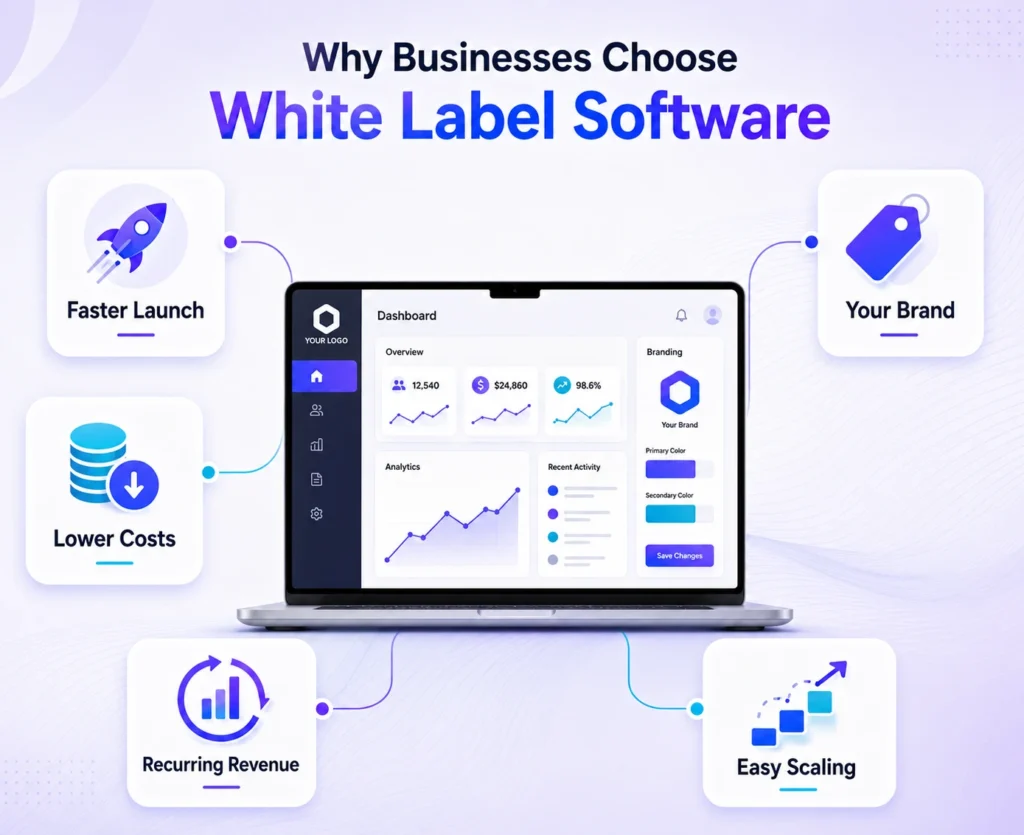
- Faster time to market: Create a new range of products within just days rather than months.
- Reduced development costs: The need to hire designers, developers and DevOps personnel is eliminated.
- Better brand recognition: Your logo and domain appear in front of your customers, rather than in front of someone else.
- Recurring income: Done with multiple white label partners, the subscription-based model entitles you to stable monthly income.
- Scalability: You can welcome new customers without incurring the costs of additional infrastructure.
Common Types of White Label Software
White label software can apply to different fields. There are many kinds of software, including the ones mentioned below, which refer to the concept of white label software:
- Marketing and reporting tools, including SEO dashboards, advertising reporting solutions, and social media management solutions
- Client relations and clientele portal software
- Project management programs
- AI chatbots and automation services — an area that is experiencing a boom in demand from businesses
- Tools for email and SMS marketing
- Website development systems and hosting panels
If you are thinking of the AI segment of white labeling, it can be useful to check the branded AI assistants we previously discussed in our review of Synthflow AI, since the domain of voice and chat automation is now developing rapidly as well.
Best White Label Software Platforms in 2026
Here’s a quick comparison of some of the top platforms agencies are using this year:
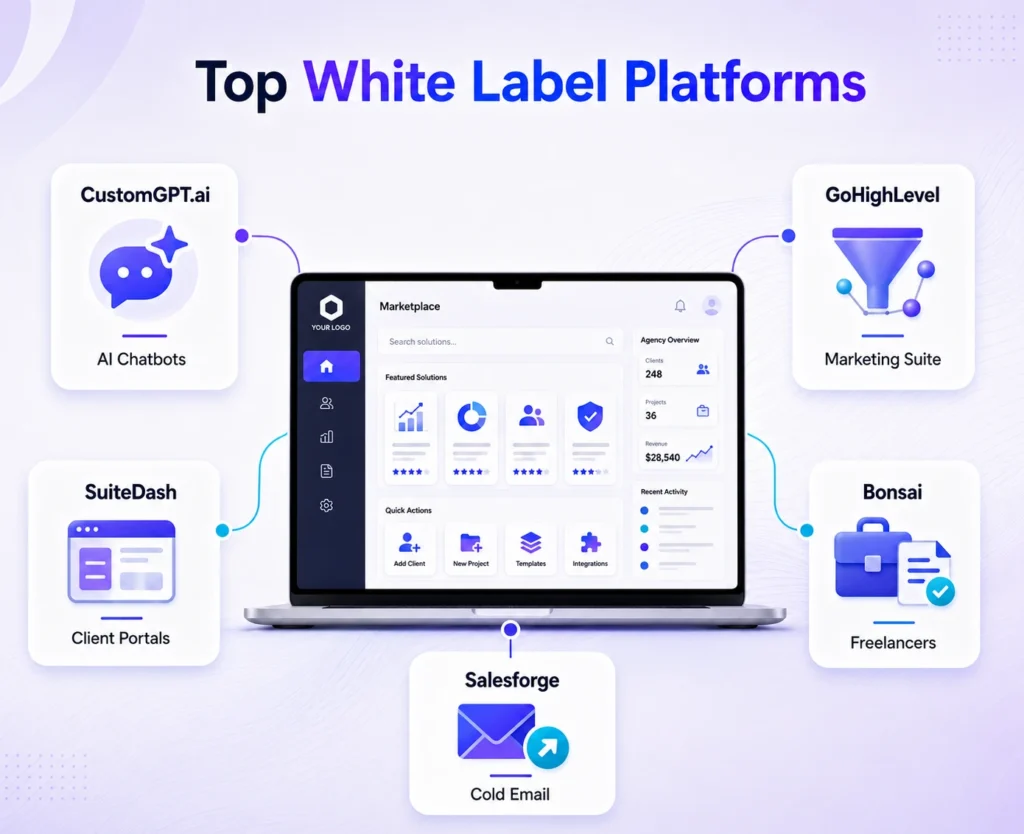
| Platform | Best For | Starting Price | Key Feature |
| CustomGPT.ai | AI chatbots & automation | Custom pricing | Fully branded AI chatbots with custom domains |
| GoHighLevel | All-in-one marketing agencies | ~$97/month | CRM, funnels, and marketing automation in one dashboard |
| SuiteDash | Client portals & billing | From $14/account (wholesale) | Branded client portal with invoicing and CRM |
| Bonsai | Freelancers & small agencies | 7-day free trial | Branded client portal, contracts, and invoices |
| Salesforge | Cold email & lead generation | Free to join reseller model | Unlimited mailboxes per client |
There is a constant change in pricing, it is better to check the actual price at each provider’s web site before signing up.
What is the difference between the White Label Software and Private Label Software?
The words are typically used in the same context, but there is a slight difference.
- White-label software is produced initially by the software maker and sold to several resellers, who all sell the same product under their own label.
- Private-label software is, as a rule, developed specifically for the individual client, with special features that will not be available for others.
Most businesses begin with white-label solutions, which are less expensive and easier to implement, and then go on to private-label ones once they grow bigger.
How to Choose the Right White Label Software
Here are a few critical warnings for anyone looking to partner with SaaS providers:
- Branding: Can you fully remove the vendor’s name from your communications or do they appear on your emails, footers, support tickets, and the like?
- Support of custom domain: Your customers should never see your vendor’s URL.
- Pricing structure: A wholesale price-per-seat generally works better than a flat fee model.
- Support and SLAs: If the backend goes down, you might be in trouble too.
- Integration: Verify the product’s capability to work with your and your clients’ tools.
If you evaluate various SaaS or AI products, check out the Business section with reviews and pricing of tools other than white label products.
Final Thoughts
The use of white label software has allowed little businesses and independent entrepreneurs to rival big businessmen without coding. Such platforms involve those in the specific niche, the ones allowing full branding control as well as affordable pricing.
To find AI-based applications that could be used in combination with white label tools, check out reviews and comparisons in our AI Tools catalog.
FAQ’s
It ultimately depends on the respective niche. When it comes to advertising agencies, they usually pick among GoHighLevel or Vendasta, businesses with a client portal preference often consider SuiteDash or Bonsai, while agencies that offer AI-enabled services more frequently turn to services like CustomGPT.ai.
In the majority of cases, indeed. It allows small businesses and freelancers to provide their clients with the means almost at the same level as enterprises, while, at the same time, not spending on purchasing the software to create new services.
The price range varies significantly from wholesale prices that start from $14 per account to enterprise solutions that could cost hundreds of dollars monthly. Most suppliers charge their clients by the number of accounts.
